How Big Should Your Outdoor Projector Screen Really Be
Choosing the right outdoor projector screen size depends on your viewing distance, space, and purpose. A screen that is too small strains your eyes, while one that is too large loses sharpness. This guide helps you find the ideal dimensions for your setup.
There is nothing quite like a backyard movie night under the stars. But before you grab the popcorn and dim the lights, one question matters a lot. How big should your outdoor projector screen really be? The answer is not as simple as bigger equals better. You need to think about your space, your projector, and what you plan to watch.
The right screen size can make or break your outdoor movie experience. Too small and everyone squints. Too large and the image looks fuzzy or washed out. This guide walks you through everything you need to know about choosing the perfect outdoor projector screen size. Let us get into it.
Key Takeaways
- Measure your viewing distance first: This determines the ideal screen width and height.
- A 100 to 120-inch screen works well for most backyards: It balances size and image quality.
- Aspect ratio matters: 16:9 is best for movies, while 4:3 suits presentations.
- Ambient light affects your choice: Brighter areas may need a larger screen with a gain surface.
- Portability is a factor: Portable screens are great for flexible setups.
- Consider your projector specs: Match your screen size to the projector’s throw ratio and brightness.
📑 Table of Contents
- Why Screen Size Matters for Outdoor Viewing
- How to Measure Your Space for the Perfect Screen
- Matching Your Screen Size to Your Projector
- Best Outdoor Projector Screen Sizes by Use Case
- Common Mistakes When Sizing an Outdoor Projector Screen
- Tips for Setting Up Your Outdoor Projector Screen
- Portable vs Fixed Outdoor Screens: Which Is Right for You?
- How Weather Affects Your Outdoor Screen Size Choice
- Final Thoughts on Choosing the Right Outdoor Projector Screen Size
Why Screen Size Matters for Outdoor Viewing
When you watch a movie indoors, the room size limits your screen. Outdoors, you have open sky and open space. That freedom sounds great, but it also means you can make mistakes more easily. A screen that looks amazing from one spot might look terrible from another.
The viewing distance is the most important factor. This is the space between your screen and your audience. If your viewers sit too close to a big screen, they see pixel gaps. If they sit too far from a small screen, they miss details. The goal is to find a sweet spot where every seat feels like the front row.
Another reason size matters is ambient light. During the day or in areas with streetlights, a larger screen can help distribute light more evenly. But it can also wash out the image if your projector is not bright enough. So size and brightness go hand in hand.
How Viewing Distance Affects Your Choice
A simple rule of thumb works well here. Multiply your viewing distance by 0.84 to get the ideal screen width. For example, if your viewers sit 15 feet away, a screen about 12.6 feet wide is ideal. That is roughly a 120-inch diagonal screen for a 16:9 aspect ratio.
Here is a quick reference to keep in mind:
- 8 to 10 feet viewing distance: 80 to 100-inch screen
- 10 to 15 feet viewing distance: 100 to 120-inch screen
- 15 to 20 feet viewing distance: 120 to 150-inch screen
- 20+ feet viewing distance: 150-inch or larger screen
These numbers give you a starting point. Your exact needs depend on your projector and the content you watch. For outdoor movie nights, most people find that 100 to 120 inches hits the sweet spot.
How to Measure Your Space for the Perfect Screen
Before you buy anything, grab a tape measure. You need to know exactly what your outdoor area can handle. This step saves you from buying a screen that does not fit or looks out of place.
Step 1: Measure Your Available Wall or Area
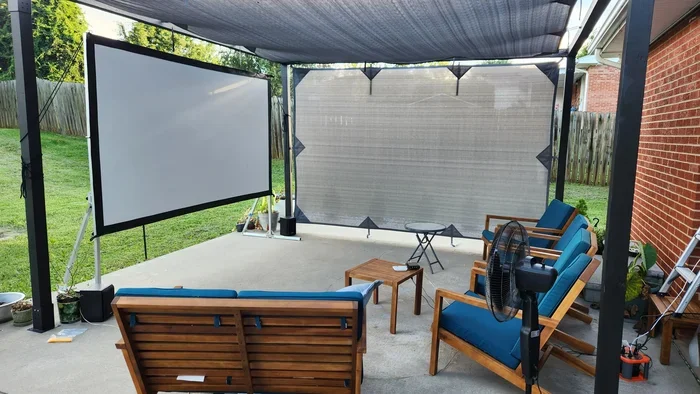
Do you have a flat wall on your house? A fence? A freestanding frame? Each option changes what size works. A smooth white wall is a great projection surface. If you do not have one, you can hang a portable projector screen or build a frame with blackout cloth.
Measure the width and height of the available surface. Also measure the height from the ground to where the screen will start. You want to make sure viewers can see the full image without craning their necks.
Step 2: Consider the Aspect Ratio
The aspect ratio is the shape of your screen. The two most common ratios are 16:9 and 4:3.
- 16:9 (Widescreen): This is the standard for movies and streaming content. Most modern projector screens use this ratio.
- 4:3 (Standard): This works well for presentations, slideshows, and older content.
If you mostly watch movies, go with 16:9. It fills the frame better and feels more cinematic. If you use your setup for games or presentations, 4:3 might be the better fit.
Step 3: Account for Screen Frame and Stand
Do not forget the frame or stand. Some outdoor projector screens come with frames that add a few inches to each side. Portable screens often need extra space for their stands or supports. Measure everything, including the stand footprint, before you commit to a size.
Matching Your Screen Size to Your Projector
Your projector and your screen are a team. One does not work well without the other. A huge screen with a weak projector looks blurry and dim. A small screen with a powerful projector wastes its potential.
Understanding Throw Ratio
The throw ratio tells you how far your projector needs to be from the screen. It is calculated by dividing the throw distance by the screen width. Most projectors have a throw ratio between 1.2:1 and 2.5:1.
For example, if your projector has a throw ratio of 1.5:1 and you want a 100-inch wide screen, the projector needs to sit 150 inches (12.5 feet) away. Check your projector manual for this number before choosing a screen size.
If you plan to make your projector wireless, you have more flexibility in placement. Wireless projectors let you position the device wherever it gets the best signal, which can help you find the ideal throw distance for your screen.
Brightness and Screen Size
Brighter projectors handle larger screens better. A projector with 2,000 to 3,000 lumens can comfortably fill a 100 to 120-inch screen outdoors at dusk. For daytime viewing, you may need 4,000 lumens or more, especially if the screen is very large.
The screen gain also plays a role. A high-gain screen reflects more light back to the audience. This can help you use a slightly smaller projector for a bigger screen. But high-gain screens often have a narrower viewing angle, meaning people sitting to the side may see a dimmer image.
Best Outdoor Projector Screen Sizes by Use Case
Different activities call for different screen sizes. Here is a breakdown of what works best for common outdoor setups.
| Use Case | Recommended Screen Size | Ideal Viewing Distance | Aspect Ratio |
|---|---|---|---|
| Backyard Movie Nights | 100 to 120 inches | 10 to 15 feet | 16:9 |
| Outdoor Sports Viewing | 120 to 150 inches | 15 to 20 feet | 16:9 |
| Golf Simulator Setup | 100 to 120 inches | 8 to 12 feet | 16:9 |
| Outdoor Presentations | 80 to 100 inches | 6 to 10 feet | 4:3 or 16:9 |
| Large Gatherings (50+ people) | 150 to 200 inches | 20+ feet | 16:9 |
For golf simulator setups, a 100 to 120-inch screen is the standard choice. It gives players a large hitting area while keeping the image sharp. You can learn more about using a regular projector for golf in our guide on can I use a regular projector for a golf simulator.
Small Gatherings (2 to 6 People)
A tight group means you can sit closer. A 80 to 100-inch screen works perfectly here. It keeps the image sharp and detailed without taking over your entire backyard. These sizes are also easy to set up and take down, making them ideal for casual outdoor movie nights.
Medium Gatherings (7 to 20 People)
This is the most common setup for families and friends. A 100 to 120-inch screen fills the view nicely from 10 to 15 feet away. Most people in this group will feel immersed in the content without any eye strain.
Large Gatherings (20+ People)
Big parties need big screens. A 150 to 200-inch screen creates a true outdoor cinema feel. But you need a powerful projector and a lot of space. Make sure everyone has a clear sightline to the screen. Elevating the screen on a projector shelf or stand can help with sightlines for larger crowds.
Common Mistakes When Sizing an Outdoor Projector Screen
Even with the best intentions, people often make mistakes when choosing their screen size. Here are the most common ones and how to avoid them.
Going Too Big for the Space
It is tempting to go as big as possible. But a screen that overwhelms your yard looks awkward and performs poorly. The image can become distorted at the edges, and viewers at the back may struggle to see details. Stick to the measurements based on your viewing distance.
Ignoring Ambient Light
Outdoor environments have lots of light. Streetlights, porch lights, and even the moon can affect your image. A larger screen spreads the projector light over a bigger area, which can make the image dimmer. If you watch during the day, choose a screen size that your projector can handle with its available brightness.
Forgetting About the Surface
A perfect screen size means nothing if your projection surface is not right. A wrinkled sheet or a dark wall will ruin the experience. Use a white projection surface or a proper screen material. If you are using a wall, make sure it is flat and smooth.
Not Planning for Storage
Large outdoor screens can be a hassle to store. Before you buy, think about where you will keep it when not in use. A portable screen that folds up is a great option if storage space is limited. You can also place your projector on a shelf or wall mount to save floor space.
Tips for Setting Up Your Outdoor Projector Screen
Once you have the right size, proper setup makes all the difference. Follow these tips to get the best results.
- Set up at dusk: The transition from daylight to dusk gives you the best balance of natural and artificial light.
- Level the ground: An unlevel screen looks crooked and distorts the image. Use a spirit level during setup.
- Secure the screen: Wind is the enemy of outdoor setups. Use stakes, weights, or sandbags to keep your screen stable.
- Position the projector at the right height: The projector lens should be centered with the middle of the screen for the best image alignment.
- Test before the big night: Run a test image a day or two before your event. Adjust the size, focus, and placement as needed.
For connecting your devices to the projector, check out our guide on how to connect your phone to a projector with HDMI. It covers the basics of getting your content from your device to the big screen.
Portable vs Fixed Outdoor Screens: Which Is Right for You?
Your screen size choice also depends on whether you want a permanent or temporary setup.
Portable Screens
Portable screens are lightweight, easy to carry, and quick to set up. They come in sizes from 80 to 150 inches. These are perfect for people who want flexibility. You can set one up in the backyard on Friday and take it down on Saturday morning.
Most portable screens use a tripod or frame stand. They work well for casual movie nights and small gatherings. The trade-off is that they may not look as polished as a fixed setup.
Fixed Screens
Fixed screens are built into a frame or stretched on a permanent structure. They offer a flatter, more uniform surface, which means better image quality. Fixed screens can go very large, sometimes 200 inches or more.
The downside is that they take up permanent space. You also need a solid structure to mount them on. A fixed outdoor screen is ideal if you have a dedicated outdoor theater area or a screened-in porch.
If you want to use your projector in multiple ways around the house, consider how you can use a projector as a TV for indoor use as well. This helps you get more value from your equipment.
How Weather Affects Your Outdoor Screen Size Choice
Weather is something many people overlook when choosing a screen size. Wind, rain, and humidity all play a role.
Large screens catch more wind. A 150-inch screen has a lot of surface area and can act like a sail. If you live in a windy area, a smaller screen or one with a sturdy frame is a safer choice. You may also want to clean and maintain your equipment regularly, especially after outdoor use in dusty or humid conditions.
Humidity can warp portable screens over time. If you live in a damp climate, choose screens made from moisture-resistant materials. Fixed screens with aluminum frames tend to hold up better than fabric ones in humid environments.
Rain is the obvious enemy of any outdoor setup. Always have a plan to quickly take down or cover your screen if weather turns. A smaller portable screen is easier to protect than a large fixed one.
Final Thoughts on Choosing the Right Outdoor Projector Screen Size
Getting the outdoor projector screen size right is all about balance. You want a screen that is big enough to feel immersive but not so big that it loses clarity or overwhelms your space. Measure your viewing distance, consider your projector specs, and think about how you will use the setup.
For most people, a 100 to 120-inch screen hits the perfect balance. It works for movies, sports, presentations, and casual gatherings. Pair it with a bright projector, a quality projection surface, and a solid setup plan, and you will have an outdoor cinema experience that everyone will love.
Take your time, plan ahead, and enjoy the show. The perfect outdoor movie night starts with the right screen size.
Frequently Asked Questions
What is the best screen size for a backyard movie night?
For most backyard setups, a 100 to 120-inch screen works best. It provides a cinematic experience without overwhelming the space. Make sure your viewers sit at least 10 feet away for the clearest image.
Can I use a regular projector for an outdoor screen?
Yes, you can. Most standard projectors work fine outdoors as long as they are bright enough. Look for at least 2,000 lumens for dusk viewing and 4,000 lumens or more for daytime use. You can also check our guide on whether a regular projector works for a golf simulator setup.
How do I calculate the right screen size for my space?
Measure your viewing distance in feet. Multiply that number by 0.84 to get the ideal screen width in feet. For example, 15 feet of viewing distance gives you about a 12.6-foot wide screen, which is roughly 120 inches diagonally.
Is a portable or fixed screen better for outdoor use?
It depends on your needs. Portable screens are flexible and easy to store, making them great for casual use. Fixed screens offer better image quality and can be larger, but they require a permanent setup. Choose based on how often you plan to use it.
Does screen size affect image quality outdoors?
Yes, it does. A screen that is too large for your projector will look dim and blurry. A screen that is too small may not fill the viewing area. Match your screen size to your projector brightness and throw distance for the best results.
What time of day is best for outdoor projector viewing?
Dusk or early evening is ideal. There is still some ambient light, but it is dim enough for the projector to produce a vivid image. Avoid midday viewing unless you have a very bright projector and a high-gain screen.
=== CONCLUSION ===
Choosing the right outdoor projector screen size does not have to be complicated. Measure your space, know your viewing distance, and match everything to your projector’s capabilities. A well-sized screen turns any backyard into a personal theater. Start with the guidelines in this article, test your setup, and adjust as needed. Soon you will be enjoying movies under the stars with the perfect picture every single time.