How Big Of A Screen Do You Need For Outdoor Movie Night
Choosing the right outdoor movie screen size depends on your space, projector, and viewing distance. A screen between 100 and 150 inches works great for most backyard setups. This guide walks you through everything you need to pick the perfect outdoor movie screen size for a memorable movie night under the stars.
Key Takeaways
- Screen Size Matters: The right screen size transforms your backyard into a true outdoor cinema experience.
- Viewing Distance Is Key: Your seating distance from the screen determines the ideal size for clear, comfortable viewing.
- Multiple Screen Options Exist: From inflatable screens to DIY setups, there is a solution for every budget and space.
- Ambient Light Affects Choice: Brighter screens work better when you cannot fully control lighting in your outdoor area.
- Projector Compatibility Counts: Your projector’s brightness and resolution should match your chosen screen size.
- Setup Simplicity Varies: Some screens inflate in minutes while others need more assembly time and effort.
📑 Table of Contents
- How Big Of A Screen Do You Need For Outdoor Movie Night
- Why Screen Size Matters For Outdoor Movies
- How To Measure The Right Screen Size For Your Space
- Types Of Outdoor Movie Screens
- Matching Your Screen To Your Projector
- Best Practices For Setting Up Your Outdoor Movie Screen
- How To Choose The Perfect Screen Size For Your Needs
- Common Mistakes To Avoid When Sizing Your Outdoor Screen
- Quick Tips For The Best Outdoor Movie Experience
- Conclusion
How Big Of A Screen Do You Need For Outdoor Movie Night
There is something magical about watching a movie under the open sky. String lights, cozy blankets, and a big screen in the backyard create memories that last a lifetime. But before you start planning your outdoor movie night, one question keeps coming up: how big should your screen actually be?
The answer is not as simple as “bigger is better.” Several factors play into finding the sweet spot. Your available space, the projector you own, and where your guests will sit all matter. In this guide, we break down everything you need to know about picking the perfect outdoor movie screen size. You will walk away with clear, actionable steps to set up an amazing backyard movie night every single time.
Whether you are hosting a small family gathering or a neighborhood block party, the right screen makes all the difference. Let us dive in and help you get it right the first time.
Why Screen Size Matters For Outdoor Movies
The size of your screen sets the entire tone for your outdoor cinema experience. Too small, and your guests will squint and lean forward. Too large, and the image quality can suffer, especially if your projector is not powerful enough. Getting the size right means everyone enjoys the show comfortably.
The Impact Of Screen Size On Viewing Comfort
Think about going to a movie theater. The screen fills your field of vision just enough to feel immersive without straining your eyes. Your backyard setup should work the same way. A screen that is too small forces viewers to sit uncomfortably close. One that is too large causes neck craning and blurry edges.
Here are a few things to keep in mind about comfort:
- Eye strain increases when the screen is too small for the viewing distance.
- Image distortion happens on the edges of oversized screens with weak projectors.
- Comfortable viewing angles mean everyone can see the full picture without turning their heads too far.
How Screen Size Affects Image Quality
Your projector has a fixed resolution and brightness output. When you stretch that image across a larger surface, each pixel spreads out. The result can look fuzzy or washed out. A smaller screen keeps pixels tighter together, producing a sharper picture.
This is why matching your outdoor movie screen size to your projector is so important. If you have a basic projector with 1,000 to 2,000 lumens, you will want to stay on the smaller side. Higher-end projectors can handle bigger screens without losing quality.
How To Measure The Right Screen Size For Your Space
Measuring for your outdoor screen is simpler than you might think. A few basic calculations will tell you exactly what size works best for your setup. Let us walk through the process step by step.
Understanding Viewing Distance
The distance between your screen and your viewers is the most important measurement. A general rule of thumb is that the viewing distance should be about 1.5 to 2.5 times the diagonal screen size. So if you have a 120-inch screen, your viewers should sit somewhere between 15 and 25 feet away.
Here is a quick reference guide:
- 80-inch screen: 10 to 16 feet viewing distance
- 100-inch screen: 12 to 20 feet viewing distance
- 120-inch screen: 15 to 25 feet viewing distance
- 150-inch screen: 18 to 30 feet viewing distance
These numbers assume a standard HD resolution. For 4K content, you can sit a bit closer because the pixel density is higher. For lower resolution sources, give yourself more breathing room.
Measuring Your Available Space
Before you buy anything, measure the area where you plan to set up. Consider these factors:
- Width: Make sure you have enough horizontal room for the screen and seating.
- Height: Check that the screen will not hit tree branches or power lines.
- Depth: Leave enough room behind the screen for the projector and its stand.
- Surface: A flat, clear area works best for stability and setup ease.
Remember to account for seating space too. Chairs, blankets, and a snack table all need room. A good layout leaves about 3 to 5 feet behind your viewers for walking space.
Accounting For Aspect Ratio
Not all screens are the same shape. The most common aspect ratios are 16:9 and 2.35:1 (ultrawide). A 16:9 screen looks like a standard TV and works great for most movies and shows. An ultrawide screen gives you that true cinematic feel but requires a wider setup area.
When choosing your outdoor movie screen size, think about what you will watch most. Family-friendly movies and TV shows look great on 16:9. Big action films and blockbusters shine on an ultrawide format.
Types Of Outdoor Movie Screens
Not all outdoor screens are created equal. Different types offer different benefits depending on your needs, budget, and how often you plan to use them. Let us explore the most popular options.
Inflatable Screens
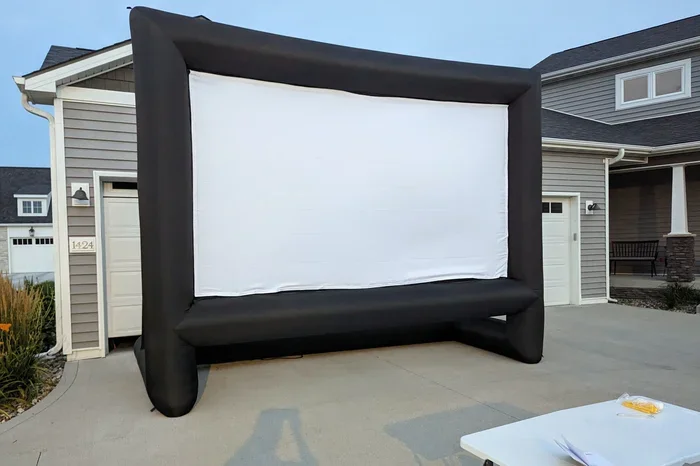
Inflatable screens are the go-to choice for most people starting out with outdoor movie nights. They are easy to set up, affordable, and come in a range of sizes from 80 inches to over 200 inches. You simply unfold them, plug in the fan, and wait a few minutes for inflation.
Pros of inflatable screens:
- Quick setup and takedown (usually under 10 minutes)
- Lightweight and portable
- Available in many sizes
- Budget-friendly options starting around $50
Cons of inflatable screens:
- Can be affected by wind if not anchored properly
- May develop small leaks over time
- Surface can wrinkle slightly in humid conditions
Fixed Frame Screens
Fixed frame screens are the premium choice for a permanent outdoor setup. They offer a perfectly taut surface that delivers the sharpest image possible. These screens mount to a wooden or metal frame and stay in place year-round.
Pros of fixed frame screens:
- Picture-perfect surface with no wrinkles
- Excellent image quality and color accuracy
- Durable and weather-resistant when stored properly
Cons of fixed frame screens:
- Higher cost (typically $200 to $1,000+)
- Requires a permanent installation spot
- Less portable than inflatable options
DIY Screens
Feeling crafty? A DIY screen can save you money and let you customize the exact size you need. You can build a frame from PVC pipes or wood and stretch a white bedsheet or projector screen material over it. Some people even use a clean white wall or fence as their screen.
Pros of DIY screens:
- Extremely affordable (often under $30)
- Fully customizable to any size
- Fun weekend project for the family
Cons of DIY screens:
- May not have a perfectly smooth surface
- Requires more effort to set up and take down
- Weather resistance depends on the material used
If you are considering a DIY approach, you might also want to check out how to use a regular projector for a golf simulator, as the setup principles for outdoor projection are quite similar.
Portable Pull-Up Screens
Pull-up screens work like large window shades. You extend them from a base and they pop up on their own. They are more stable than inflatable screens in windy conditions and offer a good balance of portability and image quality.
Pros of pull-up screens:
- Sturdy construction handles wind better than inflatables
- Fast setup (under 5 minutes)
- Good image quality for the price
Cons of pull-up screens:
- Usually more expensive than inflatables
- Heavier and less portable
- Limited size options compared to inflatables
Matching Your Screen To Your Projector
Your projector and screen are a team. One without the other will not deliver the experience you want. Let us look at how to match them properly for the best outdoor movie night results.
Projector Brightness And Screen Size
Projector brightness is measured in lumens. The brighter the projector, the larger the screen it can effectively power. Here is a simple breakdown:
- 1,000 to 2,000 lumens: Best for screens up to 100 inches. Works well in low-light conditions.
- 2,000 to 3,000 lumens: Can handle screens up to 150 inches. Tolerates some ambient light.
- 3,000+ lumens: Handles screens of 150 inches or more. Performs well even in moderate outdoor light.
If you are projecting during twilight hours, a 2,000-lumen projector with a 120-inch screen is a great starting point. For daytime viewing, you will need more brightness and possibly a screen with higher gain.
Screen Gain Explained
Screen gain refers to how well the screen material reflects light back to the viewers. A higher gain screen reflects more light, making the image appear brighter. However, higher gain screens can narrow the viewing angle, meaning people sitting off to the sides may see a dimmer image.
For most outdoor movie setups, a screen gain between 1.0 and 1.3 works well. This range provides a good balance of brightness and viewing angle. If you need more brightness for daytime use, consider a screen with a gain of 1.5 or higher.
Resolution And Screen Size
Resolution determines how sharp the image looks at a given size. A 1080p projector on a 100-inch screen looks great. On a 200-inch screen, you may start to notice individual pixels. If you want a very large screen, consider a 4K projector for crisp, detailed images across the entire surface.
Also, if you are using a streaming device like an Amazon Fire Stick or Chromecast, make sure your outdoor movie screen size matches the source resolution. Streaming 1080p content on a massive screen will not magically become 4K quality.
Best Practices For Setting Up Your Outdoor Movie Screen
Once you have chosen the right outdoor movie screen size, proper setup makes all the difference. Follow these best practices to get the most out of your backyard cinema.
Positioning Your Screen
Place your screen where it gets the least amount of direct light. Facing away from streetlights, porch lights, and the setting sun helps dramatically. If you can position the screen near a fence or wall, it provides extra stability and a surface to anchor against.
Make sure the screen is perfectly vertical. Even a slight tilt can stretch the image at the bottom and compress it at the top. Use a level during setup to get it just right.
Managing Ambient Light
Outdoor environments come with challenges you cannot control. Streetlights, porch lights, and even the moon can affect your picture quality. Here are some tips to manage ambient light:
- Turn off all unnecessary outdoor lights in the area.
- Use dark-colored backdrop fabric behind the screen to absorb stray light.
- Position the screen so the light source is behind the viewers, not behind the screen.
- Consider a high-gain screen material for better light reflection.
Audio Setup For Outdoor Movies
A great picture means nothing without good sound. Your projector’s built-in speakers are usually not enough for an outdoor setting. Consider using a portable Bluetooth speaker or connecting external speakers to your audio source.
For a more immersive experience, you can also explore options like using any speaker for DJ setups, which translates well to outdoor movie audio needs. Place speakers at ear level for the best sound distribution across your seating area.
Dealing With Wind And Weather
Wind is the enemy of outdoor screens, especially inflatable ones. Use sandbags, stakes, or heavy bases to secure your screen firmly. Check the weather forecast before your event and have a backup plan in case of rain.
For a more permanent setup, consider investing in a weather-resistant screen cover. This protects your equipment and extends the life of your screen significantly.
How To Choose The Perfect Screen Size For Your Needs
Now that you understand all the factors, let us put it all together. Here is a simple decision framework to help you choose the right outdoor movie screen size.
Small Gatherings (4 To 10 People)
For intimate movie nights with close friends or family, a screen between 80 and 100 inches works perfectly. These sizes are easy to set up, affordable, and deliver excellent image quality with most projectors. They fit in smaller backyards, patios, or even large balconies.
Medium Gatherings (10 To 25 People)
For neighborhood movie nights or birthday parties, aim for a 120 to 150-inch screen. This size provides a cinematic experience without requiring a massive setup area. Make sure your projector has at least 2,500 lumens for the best results at this scale.
Large Events (25+ People)
For big community events or block parties, go with a screen 150 inches or larger. Inflatable screens in the 150 to 200-inch range are popular for this purpose. You will need a high-lumen projector (4,000+ lumens) and a larger viewing area to accommodate everyone comfortably.
Remember that bigger is not always better. A screen that is too large for your projector will look worse than a slightly smaller screen with a crisp, bright image. Always prioritize image quality over raw size.
Common Mistakes To Avoid When Sizing Your Outdoor Screen
Even with the best intentions, many people make avoidable mistakes when setting up their outdoor movie night equipment. Here are the most common pitfalls and how to dodge them.
Skipping The Viewing Distance Calculation
One of the biggest mistakes is buying a screen based on looks alone without considering where people will sit. A massive 200-inch screen in a small backyard forces everyone to sit uncomfortably close. Always calculate your viewing distance first and let that guide your size choice.
Ignoring Ambient Light Conditions
Some people buy a screen and projector without thinking about when they will watch. A screen that works beautifully at dusk may be completely washed out during a daytime screening. Plan your setup around the time of day you intend to watch and choose your equipment accordingly.
Underestimating Setup Time
Inflatable screens are fast, but they still need a flat surface, a power outlet, and proper anchoring. Many first-timers underestimate how long it takes to get everything positioned correctly. Give yourself at least 30 to 45 minutes for a complete setup before your guests arrive.
Forgetting About Audio
It is easy to focus entirely on the visual side and forget about sound. Outdoor spaces are open and noisy, which means your audio needs to be louder and clearer than indoor setups. Test your sound system before the event starts to avoid surprises.
Quick Tips For The Best Outdoor Movie Experience
Here are some quick tips to elevate your outdoor movie setup:
- Test your setup beforehand. Run through the entire setup once before your event to work out any kinks.
- Use extension cords safely. Keep cords covered and away from walkways to prevent tripping hazards.
- Set up bug repellent. Citronella candles or bug zappers keep insects away during evening screenings.
- Have backup content ready. Download movies in advance in case streaming fails due to connectivity issues.
- Keep blankets and cushions handy. Comfort makes any outdoor gathering more enjoyable.
For those wondering about connectivity for streaming, check out whether you need temporary Wi-Fi for your outdoor setup to ensure smooth streaming during your movie night.
Also, if you plan to use a streaming stick with your projector, learn more about using a Fire Stick with a projector for a seamless setup. And for the best video and audio connection, explore whether you can run HDMI over Ethernet for longer cable runs without signal loss.
Finally, if you are using a projector as your main display, you might wonder if it can double as a TV. Find out more about using a projector as a TV to maximize your equipment investment.
Conclusion
Finding the right outdoor movie screen size does not have to be complicated. Measure your space, consider your viewing distance, match your screen to your projector, and choose a type that fits your budget and needs. Whether you go with an inflatable screen for simplicity or a fixed frame for premium quality, the goal is the same: creating an unforgettable backyard movie night that everyone will love.
Start with the guidelines in this article and adjust based on your specific setup. The beauty of outdoor movie nights is that they are personal and flexible. There is no single perfect size, only the perfect size for you and your guests. So grab some popcorn, set up your screen, and enjoy the show under the stars.
With the right outdoor movie screen size, your backyard becomes the best theater in town. Happy watching!
Frequently Asked Questions
What is the best screen size for a small backyard?
For a small backyard, an 80 to 100-inch screen works best. It provides a great viewing experience without overwhelming the space. Make sure your seating is at least 10 feet from the screen for comfortable viewing.
Can I use a regular projector for outdoor movies?
Yes, you can use a regular projector for outdoor movies. Just make sure it has enough brightness (at least 2,000 lumens) for evening use. For daytime viewing, you will need a brighter projector of 3,000 lumens or more.
How do I protect my outdoor screen from wind?
Anchor your screen with sandbags, stakes, or a heavy base. For inflatable screens, use guy lines and ground anchors. Positioning the screen near a wall or fence also helps block wind from the sides.
What is the ideal viewing distance for a 120-inch outdoor screen?
The ideal viewing distance for a 120-inch screen is between 15 and 25 feet. This range ensures viewers can see the full picture comfortably without eye strain or neck discomfort.
Do I need a special screen material for outdoor use?
Yes, outdoor screen materials are designed to be weather-resistant and wrinkle-free. They also typically have a higher gain to reflect more light. Using a regular bedsheet works in a pinch, but a proper outdoor screen material delivers much better image quality.
Can I watch daytime movies on an outdoor screen?
Yes, but you need a brighter projector and a high-gain screen. Screens with a gain of 1.5 or higher work best for daytime use. Positioning the screen in a shaded area also helps improve picture quality during the day.