Can You 3d Print A Car And Then Actually Drive It Home
Yes, you can 3D print a car and actually drive it home. The idea sounds like science fiction, but additive manufacturing has made it a real possibility. Companies like Local Motors have already built and driven fully 3D printed vehicles. 3D printing a car uses large-scale printers, specialized materials, and advanced design software to create working vehicles.
Can you 3D print a car and then actually drive it home? The short answer is yes. What once sounded like a wild sci-fi fantasy is now a real thing happening right now. Companies around the world are using 3D printing technology to build full-sized vehicles that you can register, insure, and drive on public roads. The process is fascinating, and the results are more impressive than most people expect.
When you think about 3D printing a car, you probably picture a small plastic model sitting on a desk. But modern additive manufacturing has grown far beyond that. Today, massive printers can create car chassis, body panels, and even structural components. Some of these 3D printed vehicles have been tested on highways, raced on tracks, and shown off at major auto shows. Let us walk you through everything you need to know about this exciting frontier in automotive design.
The concept of 3D printing a car combines engineering, design, and manufacturing in a way that traditional methods simply cannot match. From the initial digital model to the final drive off the lot, every step is different. In this article, we will explore how the process works, look at real examples of cars that were successfully printed, and discuss whether you could one day print your own ride and drive it home.
Key Takeaways
- 3D printed cars are real: Companies have successfully built and driven vehicles using additive manufacturing.
- The process uses large format 3D printers: These machines can print car-sized components layer by layer.
- Materials matter: ABS plastic, carbon fiber, and other composites give 3D printed cars strength and durability.
- Safety and legal rules apply: You still need to meet road regulations to drive a 3D printed car.
- The future is bright: Rapid prototyping and 3D printing technology are advancing fast in the automotive world.
- You can buy or build one: Both options exist, but building requires serious technical skill and equipment.
📑 Table of Contents
What Does It Mean to 3D Print a Car?
3D printing a car means building a vehicle using additive manufacturing processes. Instead of stamping, welding, or molding parts the traditional way, a 3D printer deposits material layer by layer until a complete component or entire vehicle takes shape. This approach is called additive manufacturing because it adds material rather than removing it.
The idea behind rapid prototyping started in the 1980s. Engineers used early printers to quickly build test models of parts. Over time, the technology improved. Printers got bigger. Materials got stronger. And eventually, people started asking a bold question: can we 3D print a car? The answer turned out to be a resounding yes.
How Additive Manufacturing Works for Vehicles
In additive manufacturing, a digital 3D model is sliced into thin horizontal layers. The printer then builds each layer one at a time, stacking them on top of each other. For a car, this means printing the chassis, body panels, and interior pieces separately and then assembling them together.
Designers use specialized software to create the digital model. They then send that model to a large format 3D printer. The printer reads the file and starts depositing material. This could be plastic, resin, or even metal depending on the printer type. The process is slow but precise, and it allows for complex shapes that would be impossible with traditional manufacturing.
One thing to keep in mind is that designing these models requires a lot of precision. When designers work on 3D models, they rely heavily on a computer mouse for precision, but there are clear advantages and disadvantages of a computer mouse for this type of detailed work. Many professionals also use tablets and styluses to get more control over their designs.
Materials Used in 3D Printed Cars
The materials you use matter a lot when you want to 3D print a car. You cannot just use any plastic and expect it to hold up on the road. Here are the most common materials used:
- ABS Plastic: Lightweight and durable. Common in consumer-grade printers and used for non-structural parts.
- Carbon Fiber Composites: Extremely strong and stiff. Used for structural components that need to bear weight.
- Polycarbonate: Tough and heat-resistant. Good for parts exposed to high temperatures.
- PLA (Polylactic Acid): Eco-friendly and easy to print. Not ideal for load-bearing car parts but useful for prototypes.
- Metal Alloys: Some advanced printers use titanium or aluminum for high-strength automotive components.
Each material has its strengths and weaknesses. The choice depends on what part of the car you are printing and what performance requirements it needs to meet.
How the 3D Printing Process Works for Cars
Building a 3D printed car is not a one-step process. It involves several stages, each requiring careful planning and execution. Let us break down how the entire manufacturing process works from start to finish.
From Digital Design to Physical Car
The first step is creating a detailed 3D model of the car. Designers use CAD (Computer-Aided Design) software to model every part. This includes the frame, body panels, dashboard, seats, and any other components. The digital model must account for structural integrity, aerodynamics, and weight distribution.
Once the design is complete, engineers run simulations to test how the car will perform. They check things like crashworthiness, heat resistance, and load-bearing capacity. If any issues come up, they go back to the digital model and adjust it. This iterative process is one of the biggest benefits of 3D printing technology.
After the design is finalized, the model is sliced into layers and sent to the printer. Engineers also need to manage all the specifications and measurements carefully. Sometimes they run into frustrating issues, like when a line won’t delete in Microsoft Excel and messes up the entire spreadsheet of parts and dimensions. Keeping data organized is critical in this stage.
The Role of Large Format 3D Printers
You cannot build a car with a small desktop printer. Large format 3D printers are essential for automotive projects. These machines have large build volumes that can accommodate car-sized parts. Some of the most advanced printers can create sections of a car chassis in a single print run.
These printers use different technologies. FDM (Fused Deposition Modeling) is the most common for large-scale automotive printing. It melts plastic filament and deposits it layer by layer. SLA (Stereolithography) uses lasers to cure liquid resin into solid layers. SLS (Selective Laser Sinning) uses lasers to fuse powdered materials together. Each method has its use cases in the automotive world.
The printing process itself can take days or even weeks for large components. A car body panel might take several hours, while a full chassis could take much longer. Speed is one of the current limitations, but printer technology is improving rapidly.
Real Examples of 3D Printed Cars You Can Drive
The idea of a 3D printed car might sound theoretical, but several real vehicles have been built and driven. These examples prove that 3D printing a car is not just a concept. It is a working reality.
The Strati by Local Motors
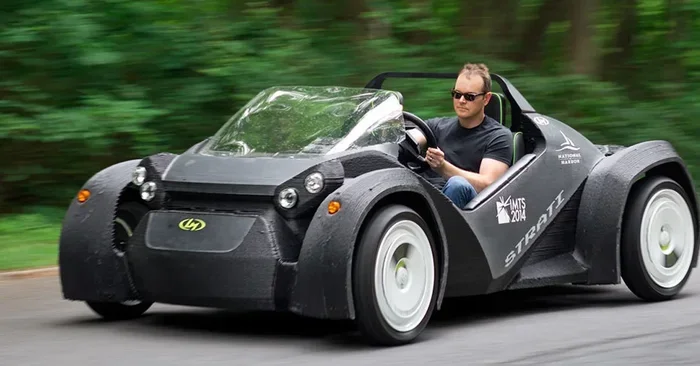
The Strati is one of the most famous 3D printed cars ever made. Built by Local Motors, it was printed in just 44 hours using a large format printer. The car has a single-piece chassis and body, which is a remarkable achievement in additive manufacturing.
The Strati is an electric vehicle that can reach speeds of about 40 mph. It has been driven on public roads and demonstrated at auto shows around the world. While it is a simple, small city car, it proved that a fully functional vehicle can be 3D printed and driven safely.
Local Motors has continued to push the boundaries of what is possible. They have printed other vehicles too, including the Olli, an autonomous shuttle bus. Each project adds to the growing body of knowledge about 3D printing technology in the automotive sector.
Other Notable 3D Printed Vehicles
The Strati is not the only example. Several other projects have shown that 3D printed cars are viable:
- Divergent 3D Blade: A supercar with a 3D printed chassis and nodes that connect carbon fiber tubes. It is lightweight and powerful.
- XEV Yoyo: A small electric city car with 3D printed body panels. It is designed for urban commuting and is already in production.
- LSEV by XEV: Another compact electric vehicle with extensive use of 3D printed components. It is one of the most affordable 3D printed cars on the market.
These vehicles show that different approaches to 3D printing a car can work. Some focus on the chassis, others on body panels, and some on the entire structure. The common thread is that all of them are road-legal and drivable.
Can You Actually Drive a 3D Printed Car Home?
This is the question most people really want answered. Can you build or buy a 3D printed car and drive it home from the factory? The answer is yes, but there are important conditions to consider.
Safety and Legal Considerations
Any car on the road needs to meet safety standards and legal requirements. A 3D printed car is no different. You need to pass safety inspections, have proper insurance, and comply with local traffic laws. In most countries, vehicles must meet specific crash safety standards, emission regulations, and equipment requirements.
The safety of a 3D printed vehicle depends on several factors. The materials used, the printing quality, and the structural design all play a role. A well-designed 3D printed car with strong materials can be just as safe as a traditionally manufactured one. But cutting corners on materials or design can be dangerous.
If you are thinking about building your own, you will need to work with engineers who understand automotive safety standards. Simply printing parts and assembling them is not enough. Every component needs to be tested and validated before it goes on the road.
Performance and Durability
How does a 3D printed car perform compared to a traditional one? The answer depends on the design and materials. Modern 3D printed components can be surprisingly strong. Carbon fiber composites and advanced polymers offer excellent strength-to-weight ratios.
Durability is another consideration. A 3D printed car needs to handle daily driving conditions. It must withstand bumps, weather changes, and regular wear and tear. Most current examples use a combination of 3D printed and traditionally manufactured parts to achieve the right balance of strength and flexibility.
Performance varies widely. Some 3D printed vehicles are small city cars with modest speed. Others, like the Divergent Blade, are high-performance machines. The technology is flexible enough to support many different types of vehicles.
Challenges and Limitations of 3D Printed Cars
While the idea of 3D printing a car is exciting, there are real challenges that need to be addressed. Understanding these limitations helps set realistic expectations.
Speed of Production
Printing a car takes time. Even with large format printers, a full vehicle cannot be printed in a few hours. The Strati took 44 hours to print its main body, and that was a relatively simple design. More complex vehicles with many components take longer.
Speed is a major bottleneck for mass production. Traditional car manufacturing lines can produce hundreds of vehicles per day. 3D printing technology is still much slower. However, this is changing as printer speeds improve and new techniques emerge.
Structural Integrity Concerns
Not all 3D printed materials are equal when it comes to strength. Some plastics are great for prototypes but not suitable for a car that will be driven on public roads. The car chassis and structural components need materials that can handle extreme forces in a crash.
Engineers must carefully choose materials and design structures that maximize strength. This often means using composite materials and reinforcing certain areas with metal or carbon fiber. The car body panels and interior parts can be printed more easily than the structural frame.
Cost and Accessibility
Building a 3D printed car requires significant investment. Large format printers are expensive. The materials are costly. And the expertise needed to design and print a safe vehicle is specialized. Right now, 3D printing a car at home is not practical for most people.
That said, costs are coming down. As the technology matures and becomes more widespread, the price of both printers and materials will likely continue to drop. This could make 3D printed vehicles more accessible to everyday consumers in the future.
The Future of 3D Printed Vehicles
The future of 3D printing a car looks incredibly promising. The automotive industry is investing heavily in additive manufacturing, and new breakthroughs are happening all the time.
One exciting development is the use of 3D printing technology for electric vehicles. EVs have fewer moving parts than traditional cars, which makes them ideal candidates for 3D printed components. Companies are exploring ways to print entire EV platforms in a single piece, reducing assembly time and cost.
Another trend is the customization of 3D printed car parts. Instead of buying generic parts, owners could print custom components that fit their specific needs. This could revolutionize the auto parts industry and make car ownership more personal and affordable.
Some experts predict that within the next decade, 3D printed cars will be a common sight on roads. The technology is advancing fast, and the benefits of additive manufacturing are too significant to ignore. From reduced waste to faster production to greater design freedom, the advantages are clear.
Car assembly using 3D printing technology could also reduce the environmental impact of manufacturing. Traditional methods produce a lot of waste material. Additive manufacturing uses only the material needed for each part. This makes it a more sustainable approach to building vehicles.
As large format 3D printers become more affordable and capable, more companies and even individuals will explore the possibility of 3D printing a car. The barrier to entry is lower than ever before. What was once limited to big corporations and research labs is now within reach of smaller teams and hobbyists.
Conclusion
So, can you 3D print a car and then actually drive it home? Absolutely. The technology exists, the vehicles have been built, and some are already on the road. 3D printing a car is no longer a dream. It is a real and growing part of the automotive industry.
From the Strati to the Divergent Blade to the XEV Yoyo, we have seen that 3D printed vehicles can be safe, functional, and exciting. The process uses advanced additive manufacturing, specialized materials, and cutting-edge printers to create working cars from digital designs.
There are still challenges to overcome. Speed, cost, and structural integrity remain areas of active development. But the progress so far is remarkable. As 3D printing technology continues to evolve, we can expect even more impressive 3D printed cars in the years ahead.
If you have ever dreamed about building your own vehicle, the future might be closer than you think. 3D printing a car is becoming more accessible, and the possibilities are limited only by imagination and engineering skill. Keep an eye on this space because the roads ahead are going to look very different.
Frequently Asked Questions
Is it legal to drive a 3D printed car on public roads?
Yes, in most cases it is legal as long as the vehicle meets all local safety and registration requirements. You will need to pass inspections, carry insurance, and comply with traffic laws just like any other vehicle.
How long does it take to 3D print a car?
The time varies depending on the complexity of the design and the size of the printer. Simple vehicles like the Strati took about 44 hours to print the main body. More complex designs can take weeks or even months.
Can I build a 3D printed car at home?
Building a full car at home is extremely challenging and requires specialized equipment. Large format printers are expensive, and you need advanced engineering knowledge. However, you can print individual car parts at home with a smaller printer.
What materials are used to 3D print cars?
Common materials include ABS plastic, carbon fiber composites, polycarbonate, and metal alloys like titanium and aluminum. The choice depends on the part being printed and its required strength and durability.
Are 3D printed cars safe to drive?
Yes, when designed and built properly. Engineers must use appropriate materials and follow safety standards. Well-designed 3D printed vehicles can meet or exceed the safety requirements of traditionally manufactured cars.
Will 3D printed cars become affordable for regular consumers?
Prices for both printers and materials are coming down. As the technology becomes more widespread, it is likely that 3D printed cars will become more affordable. Experts expect significant cost reductions within the next decade.
=== CONCLUSION ===
3D printing a car and driving it home is not science fiction anymore. It is happening now, and the technology is advancing fast. From the first prototypes to road-ready vehicles, the journey of additive manufacturing in the automotive world has been incredible.
The key takeaways are clear. 3D printed cars are real, they are drivable, and they are getting better every year. The process uses advanced printers, smart materials, and clever design to create vehicles that meet safety standards and perform well on the road.
If you are excited about this technology, stay informed. Follow the latest developments in 3D printing technology and automotive innovation. Who knows? Maybe one day you will print your own car and drive it home from your garage.