How Do I Charge My Iphone On A Plane Without Losing Power
Charging your iPhone on a plane is easier than you think. Whether you have access to airline power outlets, a portable charger, or USB charging on flights, there are multiple ways to keep your device alive. This guide covers every method, tip, and accessory you need for charge iPhone on airplane success. You will learn how to avoid iPhone battery drain and arrive with power to spare.
Ever been on a long flight and watched your iPhone battery slowly creep toward zero? It is one of the most stressful feelings in modern travel. You need your phone for boarding passes, entertainment, and staying connected. And yet, the charge iPhone on airplane experience can feel impossible sometimes.
The good news is that keeping your iPhone powered up during a flight is totally doable. You just need the right knowledge and a few smart strategies. This guide walks you through every option available today. From airline power outlets to portable charger solutions, we have you covered. By the end, you will know exactly how to keep iPhone charged from takeoff to landing.
Let us be real for a second. Air travel has changed a lot over the years. Many airlines now offer in-flight power options. But not all of them are created equal. Some give you fast charging. Others give you a port that barely works. And some give you nothing at all. That is why understanding your options matters so much. Battery saving tips and the right travel accessories can make the difference between a dead phone and a fully charged one.
Key Takeaways
- Airline power outlets exist on many flights: Check your airline’s seat map before booking to confirm airline seat power availability.
- A portable charger is your best backup: A quality power bank for travel ensures you never run out of juice mid-flight.
- Airplane mode saves significant battery: Switching to flight mode iPhone reduces iPhone battery drain dramatically.
- Not all USB ports deliver fast charging: Some airline USB charging on flights ports are slow or disabled.
- Preparation is key: Fully charge your iPhone and accessories before heading to the airport.
- Avoid common mistakes: Overcharging, using cheap cables, and ignoring battery settings can cost you power.
📑 Table of Contents
Why Your iPhone Battery Dies Fast on Flights
Before we dive into solutions, it helps to understand the problem. Why does your iPhone lose power so quickly on planes? There are several reasons, and most of them are easy to fix.
Airplane Mode and Signal Searching
When you turn on airplane mode, your phone stops searching for cell towers. This actually saves battery. But here is the catch. If you do not turn on flight mode iPhone early enough, your phone wastes energy searching for a signal during taxi, takeoff, and landing. That alone can drain 5 to 10 percent of your battery.
Also, many people leave Wi-Fi and Bluetooth on even in airplane mode. These features keep working and searching for connections. That adds to iPhone battery drain without you even noticing. The simplest fix is to turn on airplane mode the moment you board. Then re-enable Wi-Fi if the airline offers free in-flight internet.
Screen Brightness and Background Apps
Your screen is one of the biggest battery hogs. On a plane, you might crank up the brightness to fight the dim cabin lighting. That uses a lot of power. Background apps also keep running and updating, even when you are not using them.
A few simple changes help a lot. Lower your screen brightness. Close apps you are not using. Turn off push notifications for non-essential apps. These small steps add up and can easily save you 20 to 30 percent of battery life during a flight.
GPS and Location Services
Many apps use GPS in the background. Maps, weather apps, and social media all track your location. On a flight, this serves no purpose. Turn off location services for apps that do not need it. Your battery will thank you.
Charging Options Available on Airplanes
Not every plane is the same. Charging options vary widely depending on the airline, aircraft type, and seat class. Here is a breakdown of what you might find.
In-Flight Power Outlets
Many airlines now offer airline seat power in the form of AC outlets or USB ports built into the seat. These are common on domestic flights in the United States and on most international carriers. However, availability depends on your seat assignment.
Premium economy, business class, and first class almost always have power outlets. Economy class is hit or miss. Some airlines put them on every seat. Others put them on only select rows. And a few budget carriers offer no power outlets at all.
Before your flight, check the airline’s website or seat map tool. Look for symbols indicating power availability. This one step can save you a lot of frustration.
USB Ports on Plane Seats
USB port on plane options are becoming more common. Many airlines now include USB-A or USB-C ports in the seatback or armrest. These are great for long flight charging because they let you plug in your charging cable for plane without taking up an outlet.
But here is something many travelers do not know. Not all USB ports on planes deliver the same power output. Some are designed only for data transfer and charge very slowly. Others support fast charging. If you need a quick boost, look for ports labeled with a lightning bolt or power symbol.
In-Flight Charging Through Seatback Screens
Some older aircraft models have charging capabilities built into the seatback entertainment system. These ports are often USB-A and may charge at a slower rate. They work fine for keeping your phone topped up during a long flight. But they are not ideal if you need a fast charge before landing.
Best Portable Chargers for Air Travel
Even if your airline offers power outlets, a portable charger is still one of the smartest travel accessories you can carry. What happens if the outlet next to you is broken? Or what if you are on a budget airline with no power at all?
Power Banks for Travel
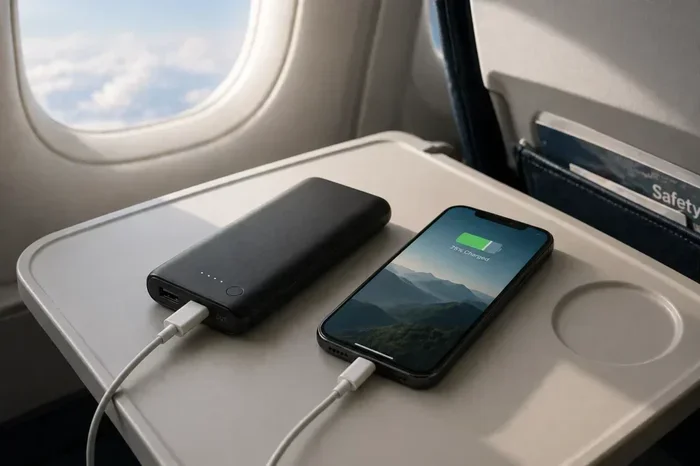
A power bank for travel is a compact, rechargeable battery that you carry in your bag. It plugs into your iPhone using a charging cable for plane and gives you extra power on the go. Most quality power banks can charge an iPhone two to four times over.
When choosing a portable charger for flights, look for these features:
- Capacity: Aim for at least 10,000 mAh. This gives you two to three full iPhone charges.
- Fast charging support: Look for power banks that support Quick Charge or USB Power Delivery.
- Size and weight: You want something compact enough to fit in your carry-on without adding bulk.
- Airline compliance: Most power banks under 100Wh are allowed in carry-on luggage. Check the FAA guidelines before flying.
Portable Power Stations
For frequent flyers and road warriors, a small portable power station can be a game changer. These devices are larger than standard power banks but offer multiple ports and high capacity. Some can charge a laptop, two phones, and a tablet simultaneously.
The trade-off is size and weight. A portable power station is not something you toss in a small bag. But if you travel often and rely on your devices, it is worth the investment.
Tips to Save iPhone Battery During a Flight
Charging your phone is only half the battle. The other half is making sure you do not waste the power you already have. These battery saving tips will help you stretch every percent.
Use Low Power Mode
iPhone has a built-in Low Power Mode that reduces energy consumption. It turns off background app refresh, reduces screen brightness, and disables some visual effects. Turn it on as soon as you board the plane. You can always turn it off when you land.
Download Content Before You Fly
Streaming music and videos over in-flight Wi-Fi drains your battery fast. Instead, download movies, podcasts, and playlists before you leave for the airport. You will use less data and less battery. This is one of the easiest battery saving tips that most travelers overlook.
Turn Off Unnecessary Features
Go through your settings before takeoff and turn off anything you do not need:
- Bluetooth – unless you are using wireless headphones
- Location Services – unless you need maps for your destination
- Background App Refresh – prevents apps from updating silently
- Auto-Brightness – manually set brightness to a comfortable but low level
- Push Email – switch to Fetch or turn off email notifications entirely
Keep Your Phone Cool
Heat is the enemy of battery life. iPhones perform worse and lose charge faster when they get hot. Avoid leaving your phone on the seatback pocket in direct sunlight. Do not leave it under a pillow or blanket while charging. Keep it in a cool, ventilated spot whenever possible.
Charge Before You Leave Home
This sounds obvious, but many people skip it. Make sure your iPhone is at 100 percent before you head to the airport. A full battery gives you the most buffer time. If you forget to charge overnight, plug it in for at least 30 minutes before you leave.
Common Mistakes People Make When Charging on Planes
Even with the best intentions, travelers make mistakes that cost them battery life. Here are the most common ones and how to avoid them.
Using the Wrong Cable
Not all cables are created equal. A cheap or damaged cable can charge your phone very slowly or not at all. Airlines sometimes provide cables, but they are often old or frayed. Bring your own high-quality charging cable for plane trips. A Lightning cable or USB-C cable from a reputable brand will work much better.
Leaving Your Phone Unattended While Charging
Some people plug in their iPhone and then go to sleep or wander the cabin. This is risky. Power surges can happen. Cables can get yanked. And you never know when a flight attendant might ask you to unplug. Stay near your phone while it charges, especially during takeoff and landing.
Ignoring Airline Charging Policies
Different airlines have different rules about in-flight charging. Some allow it during all phases of flight. Others restrict power use during takeoff and landing. Some budget carriers do not offer any power options at all. Check your airline’s policy before you fly so you are not caught off guard.
Overcharging Your iPhone
Leaving your iPhone plugged in for hours after it reaches 100 percent is not ideal. It can degrade the battery over time. If you have a long flight, charge your phone to about 80 percent, then unplug it. Let it run down a bit before plugging it back in. This cycle helps preserve battery health.
Forgetting to Pack a Power Bank
The worst thing that can happen is sitting on a 10-hour flight with no way to charge your phone. Always pack a portable charger in your carry-on, even if you think the airline has power outlets. Things go wrong. Outlets break. Seats next to you get taken. A power bank for travel gives you peace of mind.
Expert Advice for Long-Haul Flights
Long-haul flights present unique challenges for keeping your iPhone powered. A 10-hour or 14-hour flight can drain even a fully charged battery. Here is what seasoned travelers and tech experts recommend.
Layer Your Charging Methods
Do not rely on just one charging method. The smartest approach is to layer them. Use the airline seat power if available. Carry a portable charger as backup. And use battery saving tips to minimize consumption. This three-layer approach ensures you almost never run out of power.
Charge During Layovers
If you have a layover, use the time to charge your iPhone fully. Airport lounges often have plenty of outlets. Gate areas usually have seating with power ports. Even a 20-minute charge at a gate can give you enough power for the final leg of your journey.
Invest in Quality Travel Accessories
Spend money on the right travel accessories and they will serve you for years. A good portable charger, a durable charging cable for plane trips, and a multi-port USB adapter are worth every penny. These small investments pay off every time you travel.
Know Your Airline’s Charging Options
Some airlines are much better than others when it comes to airline charging options. Airlines like Alaska, Delta, and Emirates are known for offering power outlets on most seats. Budget carriers and regional airlines often lag behind. Do your research before booking and choose an airline that supports in-flight charging if this matters to you.
In the end, charge iPhone on airplane is not rocket science. It just takes a little planning and the right approach. Use the tips in this guide and you will arrive at your destination with plenty of power left. Safe travels and happy charging.
Frequently Asked Questions
Can I charge my iPhone on every airplane?
No, not every airplane has charging options. Many modern aircraft offer USB ports or AC outlets, but budget airlines and older planes may not have any power available at all. Always check your airline’s seat map or contact them directly to confirm what charging options your specific flight offers.
Is it safe to use a portable charger on a plane?
Yes, portable chargers are safe and allowed in carry-on luggage. The FAA permits lithium-ion power banks under 100 watt-hours in carry-on bags. Power banks between 100 and 160 watt-hours require airline approval. Always pack your portable charger in your carry-on, not checked luggage.
Why does my iPhone charge slowly on a plane?
Airplane USB ports often deliver low power output, which results in slow in-flight charging. Some ports are designed only for data transfer and provide minimal current. Using a high-quality cable and a portable charger with fast charging support will give you much better results than relying solely on airline ports.
Should I keep airplane mode on while charging my iPhone?
Yes, keeping airplane mode on while your iPhone charges helps it charge faster. Airplane mode reduces background activity and prevents the phone from searching for signals. This means more power goes directly to charging your battery instead of being wasted on connectivity features.
Can I use my iPhone while it is charging on the plane?
Absolutely. You can use your iPhone while it charges on a plane. In fact, using it lightly while it charges is a good way to top up your battery. Just avoid heavy tasks like gaming or streaming, which generate heat and slow down the charging process.
What is the best portable charger for flights?
The best power bank for travel is one that is compact, has at least 10,000 mAh capacity, and supports fast charging. Look for models with USB-C Power Delivery and multiple ports. Popular reliable brands include Anker, Belkin, and RavPower. Choose one that fits easily in your carry-on bag.
=== CONCLUSION ===
Charge iPhone on airplane trips without stress by using the right combination of strategies. Whether you rely on airline power outlets, a portable charger, or simple battery saving habits, you have more options than ever before. The key is preparation. Pack the right travel accessories, know your airline’s airline charging options, and use battery saving tips throughout your flight.
Remember that every flight is different. Some planes have plenty of in-flight power. Others have none. That is exactly why a good power bank for travel and smart charging habits are essential. Take care of your iPhone battery, and it will take care of you from takeoff to landing.
Start applying these tips on your next flight. You will notice the difference immediately. Your phone stays powered, your travel day goes smoother, and you never have to worry about a dead iPhone at the worst possible moment. Safe travels and happy flying.