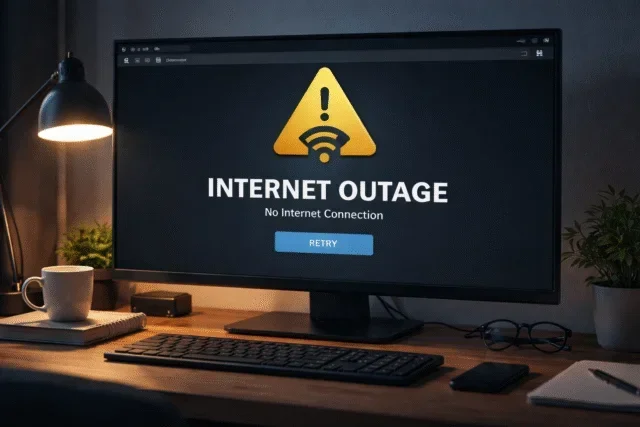
Can The Internet Be Turned Off Or Is It Impossible
Can the internet be turned off? The short answer is yes, but only partially and temporarily. While no single entity can shut down the entire global web, governments and organizations can block internet access in specific regions. The internet’s decentralized design makes a full worldwide shutdown nearly impossible, but internet outages and government censorship happen more often than you might think.
Have you ever wondered can the internet be turned off? It sounds like something out of a sci-fi movie, right? You sit there, scrolling through your phone, and think, “What if this just stopped working one day?”
The truth might surprise you. The internet is not some magic cloud floating in space. It is a massive physical network of cables, servers, routers, and data centers spread across the entire planet. And like any complex system, it has vulnerabilities. But here is the good news: turning off the internet completely is almost impossible.
In this article, we will break down how the internet actually works, look at real-world shutdowns, and answer the big question once and for all. Whether you are curious about internet infrastructure or worried about digital communication going dark, you are in the right place. Let us dive in.
Key Takeaways
- No global kill switch exists: The internet was built to be decentralized, so no one person or group can turn it all off.
- Country-level shutdowns are real: Governments in places like India, Iran, and Myanmar have successfully blocked internet access for millions.
- Internet infrastructure is fragile in parts: Submarine cables, DNS servers, and power grids can be targeted to disrupt service.
- Cyber warfare is a growing threat: State-sponsored attacks can severely damage internet connectivity in targeted nations.
- You can prepare for outages: Having backup communication tools and offline resources helps when the internet goes down.
- Full internet shutdowns are extremely rare: A complete global blackout would require an unprecedented level of coordinated destruction.
📑 Table of Contents
- How the Internet Actually Works
- Has the Internet Ever Been Turned Off?
- Can Governments Shut Down the Internet?
- Could a Global Internet Shutdown Happen?
- What Happens When the Internet Goes Down?
- Is the Internet Truly Impossible to Shut Off Completely?
- How to Prepare for Internet Outages
- Common Mistakes People Make About Internet Shutdowns
- Conclusion
How the Internet Actually Works
Before we can answer whether the internet can be turned off, we need to understand what it even is. Many people think of the internet as one single thing. But it is really a collection of millions of smaller networks all connected together.
Think of it like a giant road system. Every house, office, and building has its own small roads. Those roads connect to bigger highways. And those highways link to even larger interstate systems. The internet works the same way, but with data instead of cars.
The Physical Infrastructure Behind the Web
The internet relies on physical infrastructure that spans the globe. Here is what keeps it running:
- Fiber optic cables: These thin glass strands carry data across oceans and continents. They sit on the ocean floor and stretch through deserts and mountains.
- Data centers: These are massive buildings filled with servers that store websites, apps, and all the content you access every day.
- Routers and switches: These devices direct traffic, making sure your data gets to the right place.
- Submarine cables: Over 95% of international data travels through underwater cables. There are more than 600 of these cables in the world today.
- Satellites: Some internet access, especially in remote areas, relies on satellites orbiting the Earth.
All of this hardware has to work together for the internet to function. If one part breaks, the rest can usually pick up the slack. That is the beauty of a distributed network.
Why the Internet Is Designed to Be Resilient
The internet was not built by one company or one government. It started as a military project called ARPANET in the 1960s. The designers wanted it to survive even if parts of it were destroyed. So they created a decentralized system where data can take multiple paths to reach its destination.
This means that if one cable is cut or one server goes down, the data simply finds another route. This is why a complete internet shutdown is so hard to pull off. There is no single point of failure.
Has the Internet Ever Been Turned Off?
You might be thinking, “Okay, but has anyone actually done it?” The answer is yes, but on a local or national level, not globally. Let us look at some real examples of internet outages and shutdowns.
Country-Level Internet Shutdowns
Governments around the world have the power to block internet access within their borders. This is called an internet shutdown, and it happens more often than you might expect.
Here are some notable examples:
- India: India leads the world in internet shutdowns. In 2019, the government shut down internet access in Kashmir for months. This affected millions of people.
- Iran: Iran has rolled out complete internet blackouts multiple times, especially during protests. In 2019, the country went nearly dark for almost a week.
- Myanmar: After the military coup in 2021, the government frequently shut down the internet to control information and silence activists.
- Sudan: During civil unrest, the government has repeatedly cut off internet access to prevent coordination among protesters.
- North Korea: North Korea has one of the most restricted internets in the world. Only a tiny fraction of citizens have access to a heavily censored version of the web.
These are powerful examples of how government control of the internet works. But notice something important: these shutdowns only affect one country at a time. The rest of the world keeps going.
The Largest Internet Outages in History
Not all outages are caused by governments. Sometimes, technical failures or natural disasters cause major disruptions. Here are some of the biggest:
- The 2008 Submarine Cable Damage: An anchor dropped by a ship cut multiple submarine cables in the Mediterranean. This disrupted internet access across the Middle East, India, and Southeast Asia for weeks.
- The 2011 Egypt Shutdown: The Egyptian government ordered all internet providers to shut down. The entire country went dark in just six hours. However, the internet came back within days.
- The 2016 Dyn Cyberattack: A massive distributed denial-of-service (DDoS) attack targeted a major DNS provider. This caused widespread outages for popular sites like Twitter, Netflix, and Reddit across North America and Europe.
- The 2022 Tonga Volcano Eruption: An underwater volcanic eruption severed Tonga’s only internet cable, cutting off the entire island nation from the world for weeks.
As you can see, large-scale outages do happen. But they are always temporary and usually limited to specific regions.
Can Governments Shut Down the Internet?
This is one of the most common questions people ask. The short answer is yes, but with big limitations. Let us explore how this works and what the debate looks like.
How Governments Control Internet Access
Governments have several tools to control or block internet access within their borders:
- Ordering ISPs to shut down: Internet service providers are required by law to comply with government orders. When a government says “turn it off,” ISPs do it.
- DNS filtering: The Domain Name System translates website names into IP addresses. Governments can block certain DNS queries to prevent access to specific sites.
- Deep packet inspection: This technology allows governments to monitor and filter internet traffic in real time. They can block specific types of content or slow down certain services.
- IP blocking: Governments can block entire ranges of IP addresses, making it impossible to access certain websites or services.
- Physical cable cuts: In extreme cases, governments can order the physical destruction of internet cables within their borders.
These methods are effective for local internet shutdowns. But they do not work on a global scale. A government can only control the internet within its own territory.
The Kill Switch Debate
You may have heard the term “internet kill switch.” This refers to a theoretical mechanism that could shut down all internet communications in a country. Some countries have explored this idea, especially the United States.
In the US, the Communications Act of 1934 gives the president broad authority over telecommunications. Some lawmakers have proposed formalizing a kill switch for national security purposes. But many experts strongly oppose this idea.
Why? Because a kill switch could be misused. It could also be impossible to enforce completely. People would find ways to communicate, even if the main internet goes down. Emergency communication systems like ham radio would still work.
Quick Tip: If you are interested in staying connected during outages, consider learning about amateur radio and offline communication tools. These can be lifesavers when digital networks go down.
Could a Global Internet Shutdown Happen?
Now let us tackle the biggest question of all. Could the internet be turned off on a global scale? The answer is technically yes, but it would be an enormous challenge.
Technical Challenges to a Full Shutdown
To completely shut down the internet, you would need to destroy or disable multiple critical components simultaneously. Let us break down what that would take:
- All submarine cables would need to be cut: There are over 600 cables spanning the ocean floor. Cutting them all would require a massive coordinated effort.
- Every data center would need to go offline: There are thousands of data centers worldwide. Shutting them all down at once is practically impossible.
- All satellites would need to be disabled: Thousands of satellites provide internet access in remote areas. Destroying them all would be an incredible feat.
- Every router and server would need to be powered off: The internet runs on millions of devices. Turning them all off simultaneously would require an unprecedented level of coordination.
- The power grid would need to fail: Many internet devices rely on electricity. A complete global power grid failure would effectively kill the internet, but this is an entirely different problem.
As you can see, the number of moving parts makes a full global shutdown nearly impossible. The internet was designed to survive exactly this kind of threat.
Cyber Warfare and Internet Disruption
While a full shutdown is unlikely, cyber warfare poses a real threat to internet stability. Countries around the world are investing heavily in cyber warfare capabilities. These attacks can cause massive disruptions.
For example, a sophisticated cyberattack could target the DNS root servers. These 13 servers are the backbone of the internet’s naming system. If they were taken down, many websites would become unreachable, even if the underlying network still works.
Similarly, attacks on internet exchange points could sever connections between major networks. These points are where different internet providers exchange traffic. Taking them out could cause cascading failures across regions.
However, even these attacks would not completely eliminate the internet. They would cause significant disruptions, but recovery would be possible. The internet is remarkably resilient when it comes to bouncing back from damage.
What Happens When the Internet Goes Down?
Even though a complete global shutdown is unlikely, internet outages happen all the time. And when they do, the effects can be felt almost immediately. Let us look at what happens when the internet goes down.
The Real-World Impact of Internet Outages
We live in a world that runs on internet dependency. When the connection drops, the effects ripple through every aspect of modern life:
- Communication stops: Email, messaging apps, and social media all go dark. People cannot reach each other through digital channels.
- Financial systems freeze: Banks, payment apps, and stock markets rely on the internet. Transactions stop, and people cannot access their money.
- Healthcare is disrupted: Hospitals use connected devices and digital records. An outage could delay critical care and put lives at risk.
- Businesses lose money: E-commerce, online services, and remote work all grind to a halt. Companies lose revenue every minute the internet is down.
- Emergency services are affected: Many emergency systems now rely on digital networks. Outages can slow down response times.
The global economy loses billions of dollars every year due to internet outages. Even a few hours of downtime can cause massive disruption.
How Long Can You Go Without the Internet?
This is a question many people ask themselves. The answer depends on your situation and how prepared you are.
For most people, a few hours without the internet is an inconvenience. A few days starts to feel like a crisis. After a week or more, the effects become serious.
But humans have survived without the internet for centuries. People used to communicate through letters, phone calls, and face-to-face conversations. The internet is a tool, not a necessity for survival.
The key is to be prepared. Having offline resources, backup communication methods, and basic supplies can make a huge difference during a prolonged outage.
Expert Insight: According to networking experts, the internet’s greatest strength is also its biggest illusion of fragility. People assume that because the internet feels essential, it must be easy to destroy. In reality, its distributed architecture makes it one of the most robust systems ever built.
Is the Internet Truly Impossible to Shut Off Completely?
Let us get to the heart of the matter. Is it truly impossible to shut off the internet? The honest answer is no, it is not impossible. But it is incredibly difficult, and no single entity has the power to do it alone.
The Decentralized Nature of the Web
The biggest reason a complete shutdown is so hard is the internet’s decentralized design. There is no central hub, no main server, and no single switch. The internet is spread across thousands of networks operated by different organizations in different countries.
To shut it all down, you would need to convince or force every single network operator in the world to go offline at the same time. That is not going to happen.
Even if one country shut down its entire internet, the rest of the world would keep running. Data would simply route around the dead zone. This is the power of a distributed network.
What Experts Say About Internet Resilience
Internet engineers and researchers have studied this question extensively. The consensus is clear: the internet is built to survive.
Vint Cerf, one of the founders of the internet, has spoken about this many times. He has said that the internet was designed with redundancy in mind. There are always multiple paths for data to travel. If one path fails, another takes its place.
Other experts point out that even in the worst-case scenarios, some form of communication would survive. Ham radio, satellite phones, and mesh networks could keep people connected even if the traditional internet goes down.
So while can the internet be turned off is a valid question, the answer is nuanced. Partial shutdowns happen all the time. But a complete, permanent global shutdown is extremely unlikely.
How to Prepare for Internet Outages
Even though a full internet shutdown is unlikely, it is smart to be prepared for outages. Here are some practical tips:
- Keep a battery-powered radio: AM/FM radios can receive emergency broadcasts even when the internet is down.
- Have a power bank: A portable charger can keep your phone running during short outages.
- Download offline maps: Apps like Google Maps allow you to download maps for offline use.
- Know your neighbors: In a crisis, your local community is your best resource. Build relationships now.
- Keep cash on hand: Digital payment systems will not work without the internet. Cash is king during outages.
- Learn basic first aid: Hospitals may be overwhelmed or unable to access digital records during extended outages.
- Have a communication plan: Agree on a meeting point and a way to contact family members if digital communication fails.
These steps will not protect you from every scenario, but they will give you a significant advantage when things go wrong.
Common Mistakes People Make About Internet Shutdowns
There are several misconceptions about internet shutdowns that can lead to poor preparation. Let us clear them up:
- Mistake 1: Thinking the internet will come back instantly. Some outages last for days or even weeks. Do not assume the internet will be restored immediately.
- Mistake 2: Relying solely on your phone. Cell towers need power and backhaul connections. If the grid goes down, your phone may not work even if the internet is still running.
- Mistake 3: Ignoring offline skills. Knowing how to navigate without GPS, cook without a smart appliance, and communicate without a smartphone is incredibly valuable.
- Mistake 4: Underestimating the impact of a local outage. Even a small outage in your area can disrupt supply chains, banking, and emergency services.
Avoiding these mistakes will help you stay safe and informed during any kind of internet disruption.
Conclusion
So, can the internet be turned off? The answer is both yes and no. Yes, individual countries and organizations can shut down internet access within their borders. And yes, major outages can disrupt service for millions of people. But no, no single entity can turn off the entire global internet.
The internet was built to be resilient, decentralized, and hard to destroy. Its physical infrastructure is vast and redundant. Its design allows data to find new paths when old ones are blocked. And its global nature means that no one government or organization has control over it all.
That does not mean we should take the internet for granted. Internet outages happen. Government censorship happens. And being prepared for a world without constant connectivity is always a good idea.
The next time you wonder whether the internet can be turned off, remember this: the web is one of humanity’s greatest achievements. It is strong, adaptable, and harder to kill than most people realize. But it is also a tool. And like any tool, it works best when we understand how it works and how to live without it if we need to.
Stay connected, stay informed, and stay prepared. The internet is not going anywhere anytime soon.
Frequently Asked Questions
Who has the power to turn off the internet?
No single person, company, or organization has the power to shut down the entire global internet. However, governments can order internet service providers within their borders to block access. This has happened in countries like India, Iran, and Egypt. But these shutdowns are always limited to specific regions and are never permanent.
Has the entire internet ever been shut down?
No, the entire internet has never been shut down. There have been major outages and country-level shutdowns, but the global network has never gone completely dark. The decentralized design of the internet makes a full shutdown virtually impossible to achieve.
What would happen if the internet was turned off permanently?
A permanent global internet shutdown would cause massive economic damage, disrupt healthcare and emergency services, and fundamentally change how people communicate and do business. However, humans would eventually adapt. We lived without the internet for thousands of years, and we could do so again if necessary.
Can a cyberattack shut down the internet?
A cyberattack can cause major disruptions to parts of the internet, but it cannot shut down the entire network. Attacks on DNS servers, internet exchange points, or major service providers can cause widespread outages. However, the internet’s resilient design allows it to route around damaged infrastructure and recover over time.
How long do internet outages typically last?
Most internet outages last anywhere from a few minutes to a few hours. Some major outages caused by natural disasters or infrastructure damage can last days or weeks. Country-level shutdowns vary widely, with some lasting only hours and others lasting months.
Is the internet more vulnerable now than it was in the past?
The internet faces new threats every year, including more sophisticated cyberattacks and increasing reliance on a smaller number of major tech companies. However, the core infrastructure remains resilient. The growth of cloud computing and content delivery networks has actually made the internet more robust in many ways, even as new vulnerabilities emerge.