How Can I Charge My Phone In My Car Without Lighter
Learn how to charge your phone in your car without a cigarette lighter using USB ports, wireless charging, power banks, and more. This guide covers every practical method so you never run out of battery on the road. Whether you drive a modern car or an older model, there is a reliable solution that fits your vehicle and budget.
You are driving down the highway. Your phone battery is dropping fast. You reach for your charger and realize there is no cigarette lighter socket in sight. It happens to thousands of drivers every single day. The good news is that charging your phone in your car without a lighter is totally doable. You just need to know your options.
Modern vehicles come with all kinds of power solutions. Even older cars can be upgraded with affordable accessories. In this guide, we will walk you through every practical method to keep your phone battery full while you drive. No lighter required. Let us dive right in.
Key Takeaways
- USB Ports Work Great: Many modern cars have built-in USB ports that can charge your phone without needing a lighter adapter.
- Wireless Charging Is Easy: If your car supports it, a wireless charging pad or mount keeps your phone powered up automatically.
- Portable Power Banks Are a Lifesaver: A good car power bank charges your phone anywhere, even without any car outlet at all.
- Inverters and Adapters Open Up Options: You can convert your car’s power in creative ways to keep devices charged on long trips.
- Avoid Common Mistakes: Using the wrong cable or overdrawing power can cause problems. Always match your charger to your car’s output.
- Multiple Solutions Exist: From dashboard mounts to solar chargers, there is no shortage of ways to keep your phone alive on the road.
📑 Table of Contents
- Why You Might Not Have a Cigarette Lighter in Your Car
- Method 1: Use Your Car’s Built-In USB Ports
- Method 2: Wireless Charging Pads and Mounts
- Method 3: Portable Power Banks for Your Car
- Method 4: Car Inverters for Powering Any Device
- Method 5: Solar Chargers and Other Creative Solutions
- Common Mistakes to Avoid When Charging Your Phone in the Car
- Expert Insights on Vehicle Phone Charging
- Final Thoughts
Why You Might Not Have a Cigarette Lighter in Your Car
Many new cars have done away with the traditional cigarette lighter entirely. Automakers replaced it with a 12V socket or removed it to save space. Some vehicles now only offer USB charging ports built into the dashboard. Others have no power outlet at all in certain seating areas. Understanding why your car lacks a lighter helps you choose the best alternative.
Here are some common reasons your car may not have a lighter socket:
- Modern vehicle design: Car makers removed lighters to create a cleaner interior.
- USB-only layouts: Many new models include only USB-A or USB-C ports.
- Trim level differences: Base models sometimes skip power outlets entirely.
- Aftermarket removal: Previous owners may have removed the lighter socket.
No matter the reason, the solutions below will help you stay powered up. Each method works independently of a cigarette lighter, so you can mix and match based on your needs.
Method 1: Use Your Car’s Built-In USB Ports
Finding the USB Ports in Your Vehicle
Most cars made after 2015 come with at least one USB charging port. These ports look like small rectangular slots on the dashboard, center console, or even in the rear armrest. They are designed primarily for data transfer but also deliver power to charge devices.
To find your USB ports, check these common locations:
- Front dashboard area near the gear shift
- Center console between front seats
- Rear seat armrest
- Under the steering column
- In the glove compartment
USB-A vs USB-C: What You Need to Know
Not all USB car ports are the same. Older cars often have USB-A ports, which deliver lower power. Newer vehicles may include USB-C ports that support faster fast charging. Here is a quick comparison:
- USB-A: Typically delivers 2.5W to 12W of power. Works with most standard charging cables.
- USB-C: Can deliver 18W to 100W with the right cable and car support. Ideal for fast phone charging.
If your car only has USB-A ports, you may notice slower charging speeds. This is normal. Using a short, high-quality charging cable can help improve the power delivery. Look for cables rated for car charging to get the best results.
Tips for Better USB Charging
Follow these quick tips to get the most out of your car’s USB ports:
- Use a short cable to reduce power loss over distance.
- Avoid charging while using heavy apps like GPS or streaming.
- Turn off background apps to reduce power draw.
- Check your cable quality. Cheap cables often charge slowly or not at all.
- Use a car phone mount with a built-in USB port for a clean setup.
Method 2: Wireless Charging Pads and Mounts
How Wireless Car Charging Works
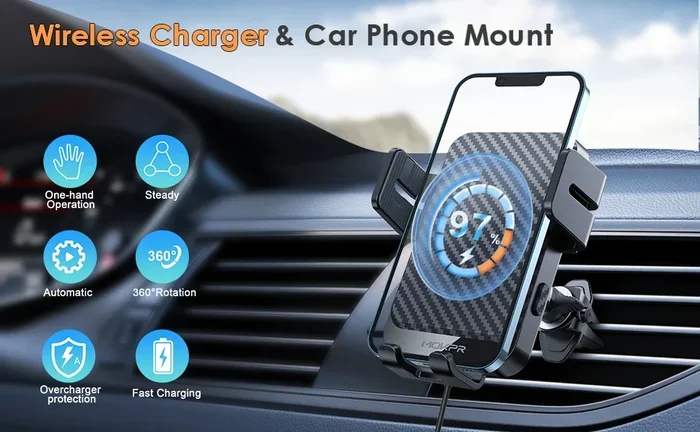
Wireless charging has become one of the most popular ways to power up your phone in the car. A wireless charging pad or mount uses electromagnetic induction to transfer energy to your phone. You simply place your phone on the pad, and it starts charging. No cables needed.
Many modern phones support Qi wireless charging. This is the most common wireless charging standard. If your phone has a glass back, it likely supports Qi. iPhones from the iPhone 8 onward and most Android flagships work with wireless charging pads.
Best Wireless Charging Options for Your Car
There are several types of wireless car chargers available. Here are the most popular options:
- Dashboard wireless mounts: These clip onto your dash and hold your phone in place while charging wirelessly.
- Vent-mounted wireless chargers: These attach to your air vent and hold the phone upright for easy viewing.
- CD slot wireless chargers: These insert into your CD player slot and charge your phone while it sits in front of you.
- Wireless charging pads: Flat pads you place on your console or dashboard. Simple and effective.
When choosing a wireless charger for your car, look for models that support fast wireless charging. Some pads charge at 10W or 15W, which is close to what a wired charger delivers. Make sure the charger is compatible with your phone model before buying.
Pros and Cons of Wireless Car Charging
Wireless charging is convenient, but it is not perfect for every situation. Here is a quick look at the advantages and disadvantages:
- Pros: No cables to manage, easy one-step charging, reduces wear on your charging port, and works well with a phone mount.
- Cons: Slightly slower than wired charging in most cases, requires a compatible phone, and the pad needs to stay connected to a power source.
Method 3: Portable Power Banks for Your Car
Why a Car Power Bank Is a Great Backup
A portable power bank is one of the most versatile solutions for charging your phone in the car. These devices store electrical energy in a built-in battery. You charge the power bank at home, then bring it with you in the car. When your phone needs juice, you plug it in. No car outlet required.
Power banks are especially useful for road trips, camping trips, or daily commutes where access to a power source is limited. They work in any car, regardless of whether it has a lighter socket or USB port.
Choosing the Right Power Bank
Not all power banks are created equal. Here are the key factors to consider:
- Capacity: Measured in mAh. A 10,000mAh power bank can charge most phones 2-3 times. A 20,000mAh bank can do even more.
- Output speed: Look for power banks that support fast charging with QC 3.0 or PD technology.
- Number of ports: Multiple USB ports let you charge more than one device at a time.
- Size and weight: Choose a compact model that fits easily in your glove box or center console.
- Car charging capability: Some power banks can themselves be recharged using a car adapter or cable.
Top brands like Anker, Belkin, and Nekteck make excellent car-friendly power banks. Look for models with both USB-A and USB-C outputs for maximum flexibility.
Quick Tips for Power Bank Use
Get the most from your portable power bank with these simple tips:
- Recharge your power bank fully before every trip.
- Store it in a cool, dry place to preserve battery life.
- Use the right cable for the fastest charging speed.
- Label your power bank so everyone in the car knows where it is.
- Keep it charged even when not in use. Power banks lose charge slowly over time.
Method 4: Car Inverters for Powering Any Device
What Is a Car Inverter?
A car inverter converts your car’s DC power into AC power, just like a wall outlet at home. This means you can plug in almost any device that uses a standard wall charger. Some inverters even have built-in USB ports for direct phone charging.
Inverters are a fantastic option if your car has a 12V socket but no lighter. You plug the inverter into the 12V socket, and then use your regular phone charger just like you would at home. It is simple and effective.
Types of Car Inverters
There are two main types of inverters you can use:
- Pure sine wave inverters: These provide clean, stable power. They are safe for sensitive electronics like phones and laptops. They cost a bit more but deliver the best performance.
- Modified sine wave inverters: These are more affordable but produce slightly less clean power. They work fine for most car accessories but may not be ideal for all devices.
For phone charging, either type will work. But if you plan to charge laptops or other sensitive devices, a pure sine wave inverter is the safer choice.
Method 5: Solar Chargers and Other Creative Solutions
Solar Car Chargers
Solar chargers are an eco-friendly way to keep your phone battery topped up. These small panels sit on your dashboard or attach to your windshield. They absorb sunlight and convert it into electrical energy to charge your phone through a USB connection.
Solar chargers work best in sunny conditions. They are not the fastest option, but they are great for emergencies or long parking sessions. You can leave one on your dashboard while running errands, and your phone will gain some charge by the time you return.
Other Creative Charging Ideas
If the methods above do not fit your situation, consider these creative alternatives:
- Battery pack with built-in cables: Some car power banks come with retractable cables so you do not need to carry a separate charger.
- Multi-port car chargers: These plug into any available socket and offer multiple USB ports for family trips.
- Hand-crank chargers: These manual chargers generate power through cranking. They are not common but work in true emergencies.
- Dash-mounted wireless pads: These combine a wireless charging pad with a phone mount for a sleek, cable-free setup.
Common Mistakes to Avoid When Charging Your Phone in the Car
Using Cheap or Damaged Cables
One of the biggest mistakes people make is using low-quality charging cables. Thin, cheap cables can cause slow charging, overheating, or even damage to your phone. Always use cables from reputable brands or those certified for fast charging. Inspect your cables regularly for fraying or damage.
Overloading Your Car’s Electrical System
Plugging too many devices into one power source can overload your car’s electrical system. This can blow a fuse or drain your car battery when the engine is off. Be mindful of how many devices you are charging at once, especially if you are using an inverter or adapter.
Ignoring Charging Speed Differences
Not all car charging methods deliver the same speed. USB-A ports often charge slowly compared to USB-C or wireless fast charging. If you need a quick boost, choose the fastest method available. A portable power bank with fast output can often charge your phone faster than a car’s built-in USB port.
Forgetting to Turn Off Chargers When the Engine Is Off
Leaving a charger plugged in when your engine is off can slowly drain your car battery. Make it a habit to unplug your charger when you turn off the engine. This small habit can save you from a dead car battery on a busy morning.
Expert Insights on Vehicle Phone Charging
Automotive and tech experts agree that the best approach is to have multiple charging options available. Car phone charger expert Mark Benson recommends keeping a backup power bank in your vehicle at all times. “You never know when you will need it,” he says. “A dead phone on the road is more than an inconvenience. It can be a safety issue.”
Auto technician Sarah Lin adds that USB-C ports are the future of vehicle charging. “If you are buying a new car, look for one with USB-C support,” she advises. “It makes a huge difference in charging speed and convenience.”
Both experts also emphasize the importance of using quality accessories. Cheap knockoff chargers may seem like a good deal, but they can damage your phone or drain your car battery over time. Investing in reliable car accessories pays off in the long run.
Final Thoughts
Charging your phone in your car without a cigarette lighter is easier than you might think. From built-in USB ports to wireless charging pads, portable power banks, and even car inverters, there is a solution for every driver and every vehicle. The key is knowing your options and choosing the method that fits your lifestyle.
Start by checking what power sources your car already has. Then add the right accessories to fill in the gaps. Keep a quality charging cable and a backup power bank in your car at all times. With the right setup, you will never have to worry about a dead phone while driving again.
Take action today. Pick one method from this guide and try it out on your next drive. Your phone battery will thank you, and you will enjoy peace of mind knowing you are always connected on the road.
Frequently Asked Questions
Can I charge my phone in my car without any outlet at all?
Yes, you can. A portable power bank stores energy and charges your phone through a USB cable. You simply charge the power bank at home and bring it with you in the car. This is one of the most reliable methods for phone charging without any car outlet.
Is wireless charging slower than wired charging in the car?
Generally, yes. Most wireless car chargers charge at 10W or 15W, which is slightly slower than a good wired connection. However, fast wireless charging pads are closing the gap. For most drivers, the difference is barely noticeable during a typical commute.
Will using a car inverter drain my car battery?
It can, if you leave it running with the engine off. A car inverter draws power from your vehicle’s electrical system. To avoid draining your battery, only use the inverter while the engine is running. Unplug it when you turn off the car.
What is the best power bank for car use?
Look for a power bank with at least 10,000mAh capacity, fast charging support, and both USB-A and USB-C ports. Brands like Anker and Nekteck make excellent car-friendly power banks that are compact and reliable for on-the-go charging.
Can I install a USB port in my older car?
Absolutely. You can install an adapter that plugs into your car’s existing 12V socket and provides USB-A and USB-C outputs. These adapters are affordable and easy to install. They are a great way to add modern charging capabilities to older vehicles.
How do solar car chargers work?
Solar car chargers use photovoltaic panels to convert sunlight into electrical energy. They connect to your phone via USB. They work best in direct sunlight and are ideal as a backup option. They charge slowly but are a great eco-friendly solution for keeping your phone powered during the day.
=== CONCLUSION ===
Now you know exactly how to charge your phone in your car without a lighter. Whether you rely on built-in USB ports, wireless charging, a portable power bank, or a car inverter, there is a solution that works for you. Keep your charging cable handy, invest in quality accessories, and never let a dead phone ruin your day on the road again.